


If you’re running a mold or die shop, or you’ve ever ordered a precision component that needs that flawless, scratch-free surface, you’ve probably wondered about all the tiny variables that make a mirror finish happen. As the owner of a mirror finish die sinker EDM supplier, I get questions about this all the time—mostly centered on material hardness, because it’s one of those make-or-break factors that most folks underestimate at first. Let’s break this down, no stuffy textbook jargon, just real talk from someone who’s seen this play out in hundreds of jobs.

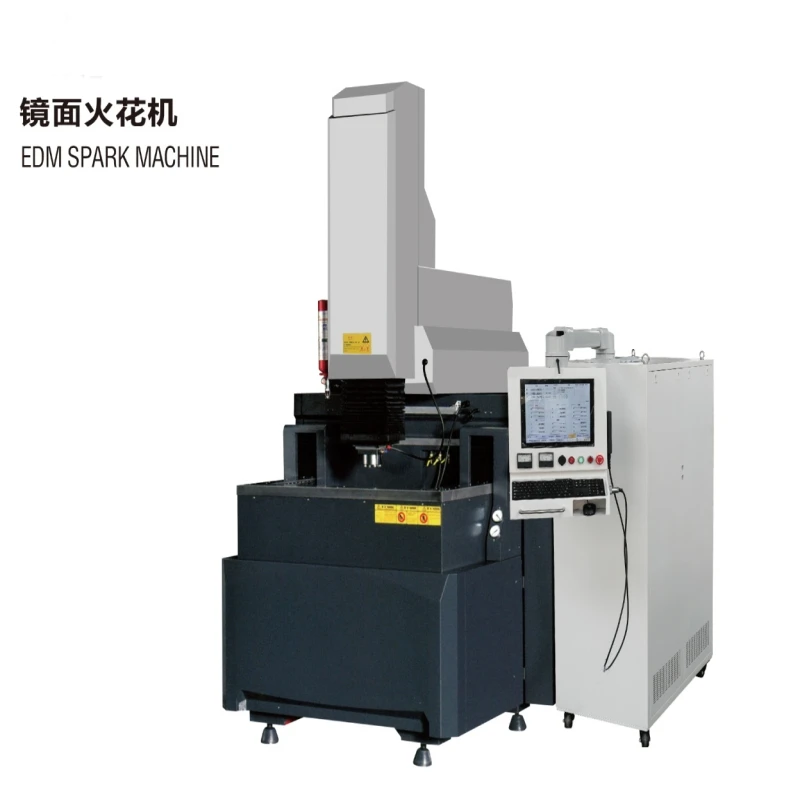
First, let’s keep it simple: die sinker EDM works by eroding material with a series of tiny, controlled electrical sparks between a tool electrode (usually copper or graphite) and your workpiece. No physical cutting, no pressure, which is why it’s perfect for hard materials that would destroy mills or grinders. But material hardness directly messes with how those sparks behave, how fast material is removed, and, most importantly, that mirror finish we all want.
I’ve got a go-to example from last quarter: a customer making a plastic injection mold for a luxury smartphone case. The cavity was made from H13 tool steel, heat-treated to 52 HRC (Rockwell C, the standard for hard materials in tooling). They first tried machining it with a conventional die sinker EDM and got a finish of Ra 0.8 microns—nice, but not a mirror. They switched to our CM450 Mirror Finish Die Sinker EDM Machine (that’s our workhorse for medium-to-large dies) and cranked up the settings, but still couldn’t get below Ra 0.2 microns until we adjusted for the material’s hardness. That’s the thing: hardness doesn’t just slow down EDM—it changes every part of the process.
Let’s start with material removal rate (MRR), because no shop wants to wait a week for a single cavity. Soft materials, like annealed aluminum (20 HRC) or pre-hardened P20 steel (30 HRC), erode way faster. The sparks don’t have to work as hard to melt and vaporize tiny bits of material—think of it like cutting butter vs. cutting hard candy. But when you jump to 50+ HRC (tool steels like H13, D2, or even high-alloy steels used for aerospace parts), each spark has to apply more energy to break through the material’s tight, dense grain structure. I’ve measured MRR drops of 60-70% when going from 30 HRC to 55 HRC on the same EDM machine. That’s a big deal for lead times, especially when you’re running multiple cavities.
But here’s the catch: even if you can speed things up, the surface finish will suffer if you don’t adjust your parameters for hardness. Soft materials have more ductile grain structures, so when sparks hit, the molten material splatters more, leaving tiny burrs or craters. Hard materials have smaller, more uniform grains, so sparks create smaller, more consistent craters—if you use the right energy settings. If you run high energy on a hard material, those craters get way too big, and the residual heat from each spark causes micro-cracks in the surface. Last year, a customer brought in a D2 steel die (58 HRC) that had micro-cracks from a competitor’s EDM job—they needed us to redo it with our CM300 Mirror Finish Die Sinker EDM Machine (our compact, high-precision model for small, tight-tolerance parts) and run very low-energy, long-pulse settings to avoid that heat damage. We got Ra 0.15 microns (that’s actual mirror finish—you could see your reflection in the cavity) with zero cracks, but it took twice as long as a soft P20 steel die of the same size. That trade-off between speed and finish is all dictated by hardness.
Another big one: electrode wear. No one wants to replace their tool electrode mid-job, especially expensive copper ones. Harder materials wear electrodes differently. On soft materials, the sparks tend to wear the edge of the electrode more, because the material erodes unevenly. On hard materials, the sparks are more focused, so electrode wear is slower and more consistent. I’ve had a customer run a 100-hour job on a 55 HRC tool steel die with a single copper electrode—no need to re-trim or replace it—whereas on a 30 HRC P20 steel die, they’d go through two electrodes in the same time. That’s a huge cost saver, but it only works if you match the EDM settings to the material’s hardness. If you run low-energy settings on a soft material, you’ll get electrode wear that’s too slow, leading to inconsistent sparks. Run high-energy on a hard material, and you’ll burn through the electrode in no time.
Wait, let’s talk about that mirror finish itself—what makes a surface truly a mirror, not just “smooth”? It’s about Ra (arithmetic mean roughness) being below 0.2 microns, usually, and having no micro-craters, burrs, or heat-affected zones (HAZ). The HAZ is a thin layer of material just below the surface that’s been heated by sparks, making it brittle. That’s a killer for parts that need to withstand pressure or repeated use, like injection molds. Harder materials have a smaller HAZ if you run the right settings, because their dense structure dissipates heat faster. Soft materials, on the other hand, hold heat longer, so the HAZ is thicker and more prone to micro-cracks. I always tell customers: if you want a mirror finish and long part life, pair your material hardness with EDM settings that match. For 40-50 HRC materials, we use medium-energy, pulse-on times of 10-20 microseconds. For 55+ HRC, we drop to low energy, pulse-on times of 2-5 microseconds, even if it slows down the job. That’s non-negotiable for us, because we don’t want to send out parts that fail after a few runs.
I should also mention a common mistake I see all the time: people assume all mirror finish EDM machines work the same, no matter the material. Nope. Our CM450 and CM300 machines are tuned specifically to adjust spark energy, pulse time, and flushing pressure in real time based on material hardness. Flushing is another variable I haven’t mentioned yet—EDM uses dielectric fluid to flush away eroded material, and harder materials produce smaller, finer particles. If you use the same flushing pressure for a hard material as you would for a soft one, you’ll either blow the particles away too fast (leading to inconsistent sparks) or not fast enough (causing short circuits that mess up the finish). Our machines have adaptive flushing that adjusts based on the spark feedback, which is why we can get that mirror finish even on super hard materials like 60 HRC powder metallurgy steels.
Let’s wrap this up with a real-world win. A aerospace customer came to me last year needing a fuel injector component made from 440C stainless steel, heat-treated to 59 HRC. They’d tried 3 other EDM suppliers, and all got a finish of Ra 0.3 microns, which was too rough for their specs. They used our CM300 Mirror Finish Die Sinker EDM Machine, adjusted the settings for the 59 HRC material, and ended up with Ra 0.12 microns—perfect, mirror-like surface, no HAZ, and the job finished on time. The difference? We didn’t treat the material like a generic workpiece; we adjusted every EDM parameter around its hardness.
If you’re working on a job that needs a mirror finish, don’t just pick an EDM machine and crank the settings. Ask yourself: what’s the material hardness? Is it going to slow down the job? Do I need to adjust for electrode wear or flushing? For us, that’s our whole game—we don’t sell machines, we sell solutions tailored to your material’s needs, whether it’s a soft aluminum mold or a super-hard aerospace component.
If you’ve got a project where material hardness is messing with your mirror finish, or you want to chat about which of our machines would work best for your material and specs, reach out. No sales pitch, just real advice from someone who’s been in the trenches with this stuff for years.
References
- Kunieda, M., Lauwers, B., Rajurkar, K. P., & Schumacher, B. M. (2005). Advancing EDM through fundamental insight into the process. CIRP Annals, 54(2), 64-87.
- Ho, K. H., & Newman, S. T. (2003). State of the art electrical discharge machining (EDM). International Journal of Machine Tools and Manufacture, 43(13), 1287-1300.
- Tullis, J. (1992). Rockwell hardness testing: A practical guide. ASTM International.