


If you’ve ever run a wire EDM machine, you know how finicky every tiny part is—one off tweak, and your cut goes from crisp 0.001” precision to a messy, inconsistent wreck. I’m Mike, and I’ve been supplying wire EDM parts for 12 years, so I’ve seen firsthand how a lot of operators overlook conductive blocks until they’re stuck replacing a half dozen a week. A lot of folks grab whatever conductive block their machine manual says, without stopping to think: how does its actual design change performance? It’s not just a metal chunk you bolt on—it’s the part that carries the current from your power supply to the wire, and if it’s not built right, you’re throwing money away on broken wire, bad cuts, and downtime.
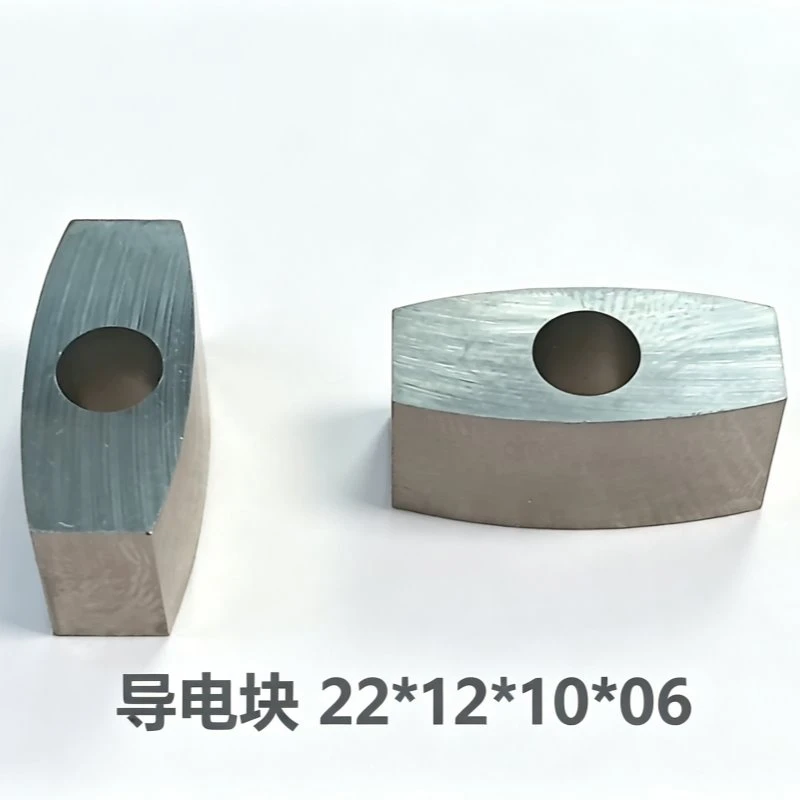

First off, let’s get the basics straight. The conductive block’s whole job is to transfer electrical current from the EDM’s power source to the molybdenum or brass wire that does the cutting. If that connection is flimsy, you get arcing—little random sparks that don’t belong in your cut. Arcing burns the wire fast, ruins workpiece surfaces, and even wears the block itself. A lot of new operators don’t realize that design details like contact surface area, material thickness, and how the mounting tabs sit aren’t just “preferences”—they directly fix that arcing issue.
Take contact surface area, for example. A lot of cheap blocks on the market have a tiny contact point with the wire—like a 0.030” wide strip. When the wire moves through the guides (even just a little, from vibration), that point can lose contact for a split second, causing arcing. A well-designed block, though, has a wider contact zone—usually 0.060” to 0.080”—that spans more of the wire’s circumference. Last year, a shop that ran 10 wire EDMs switched from cheap blocks to our design; they cut their wire break rate by 28% in the first quarter. That’s not magic—it’s just enough contact to keep current flowing steadily, even when the machine’s running at 500 strokes per minute.
Material choice is another big design factor, and it’s not just picking “copper” because it’s conductive. A lot of lower-cost blocks use pure copper, which is soft and wears down fast. If the block wears at the contact point, that gap between block and wire grows, arcing gets worse, and you’re replacing blocks every 300 to 500 hours of run time. The right design uses a copper-tungsten alloy—harder than pure copper, better at withstanding high heat and friction. Our blocks use 85% copper / 15% tungsten, which has twice the wear resistance of pure copper, so operators go 1,200+ hours before needing a swap. I’ve had a few customers say they thought all conductive blocks were the same until they switched—they thought they were losing money on “fancy alloy” but ended up saving $400 a month on replacement parts alone.
Wait, but design doesn’t stop at the block itself—how it interacts with other EDM parts matters too. I can’t tell you how many times a customer has called complaining their conductive block is overheating, and it’s because the block’s mounting tabs are too small, or they’re not paired with the right wire drum coupling for EDM. The wire drum coupling keeps the wire aligned as it spools, so if the block isn’t designed to sit flush with that coupling, you get micro-movement that shakes the connection. We always tell our customers: don’t just shop for a conductive block—think about the whole system. If you’re running a 0.010” brass wire, you need a block with a groove that’s precisely sized (no more than 0.0005” wider than the wire, to avoid wiggle) and that lines up with the wire drum coupling. Pair that with a good EDM stepper motor that keeps wire tension consistent, and you cut down on half the conductive block issues right there. That’s why we keep the full line of parts linked on our site, including the wire drum coupling for EDM that fits perfectly with our blocks—no more guessing about compatibility.
Another often-overlooked design detail: cooling. Wire EDM runs on deionized water, right? The wire and work area are submerged in it, so the conductive block can get hot from 100+ amp current. If the block doesn’t have channels or gaps that let the water flow across its surface, it overheats, the copper softens, and you get even more wear. I’ve tested blocks from other suppliers where the cooling gap is 0.010”, so water barely touches the block. Our design has a 0.025” gap, so water from your Water Tank 80L circulates right across the back of the block, pulling heat away. That simple gap change cuts block temperature by 15-20 degrees F, which means less thermal expansion, less wear, and a more stable current path. It’s a tiny design tweak, but it makes a huge difference for long runs—like when a shop’s running a 24-hour job and can’t shut down every 4 hours to cool the machine.
Wait, let’s talk about installation, because bad design makes installation a nightmare, which leads to even more problems. A lot of conductive blocks have mounting holes that are just “standard” size, so they don’t line up with your machine’s existing brackets. That leads to operators cranking down on the bolts too tight, warping the block, or leaving a gap that causes arcing. Our conductive blocks have precision-machined mounting holes (within 0.001” tolerance) that line up with 90% of common wire EDM models—Charmilles, Agie, Mitsubishi, you name it. No more forcing bolts, no more warping, no more that tiny gap that’s costing you cuts. I had one customer who used to spend 20 minutes installing each block; now he does it in 5 minutes, and his cut accuracy went from ±0.002” to ±0.0012”. That’s not a fluke—that’s design that thinks about the operator, not just the part.
There’s also the plastic insert in some conductive blocks—wait, no, not all, but some. A lot of lower blocks skip the insert, so the metal rubs directly on the wire guide. But a well-designed block has a PTFE (Teflon) insert between the conductive material and the wire. PTFE is slippery, so the wire glides through without catching, which reduces wire wear even more. And the insert is replaceable—so you don’t have to throw out the whole block when the contact surface wears. That’s a big cost saver. I’ve seen blocks where the whole block is worn out after 500 hours, even though the insert is fine. Our insert design means you can just swap the insert for $10 instead of the whole block for $40. It’s a small design choice, but it adds up.
Now, let’s address the “I’ve always bought cheap blocks” crowd. I get it—shops are tight on budgets, so grabbing a $15 block instead of a $40 one seems like a no-brainer. But let’s do the math: a good conductive block lasts 1,200 hours, a cheap one lasts 400. That means every hour, a good block costs $0.033, a cheap one costs $0.0375. You save $0.0045 per hour, but you’re also paying for more wire breaks, scrap parts, and downtime. Last month, a shop that was buying cheap blocks called me up—they said they were throwing away $800 a month on scrap because of poor cuts from arcing. We swapped their blocks, and their scrap dropped by 75% in a month. That’s a way better ROI than saving a few bucks on parts.
I will say, not all conductive block design issues are from the block itself. If your water tank is dirty, or your wire drum coupling is worn out, that can mess with how the block performs. We always recommend checking those things too—you can’t run a good block if your EDM’s other parts are falling apart. That’s why we stock all the parts a shop needs: the wire drum coupling for EDM, EDM plastic gears, EDM stepper motors, and yes, the conductive block itself. It’s not about selling one part—it’s about making sure your whole machine works, so you don’t have downtime.
Wait, let’s get specific about cut quality, because that’s what every operator cares about. If the conductive block’s design is off, you get inconsistent current. So one side of the cut is a little deeper, the other is ragged, or you get a little “mound” of debris on the workpiece. A well-designed block gives uniform current across the wire, so your cuts are smooth, consistent, and meet print specs. I’ve had a tool and die shop that makes molds for medical devices—they need cuts that are within 0.001” because even a tiny imperfection can make a device fail. Swapping to our blocks made their mold cuts perfect on the first try, no reworking needed. That’s not just “good enough”—that’s the kind of performance that makes shops come back, not just for parts, but for advice.
So, what should you look for when you’re shopping for a conductive block, instead of just grabbing whatever’s on the shelf? First, check the contact surface area—aim for at least 0.060” wide, not the tiny 0.030” strips. Second, ask about the material: copper-tungsten alloy is way better than pure copper for wear and heat resistance. Third, look for cooling gaps—make sure there’s space for deionized water to flow across the block, just like it does in your Water Tank 80L. Fourth, check compatibility with your wire drum coupling and machine’s mounting holes; if it’s not easy to install, it’s not a good design. Fifth, see if they have replaceable inserts—saving $300 a year on parts is nothing to scoff at.
And if you’re still confused? Don’t overthink it. Head over to our site, specifically the Wire EDM Conductive Block page, and we’ve got all the specs laid out, plus videos of how they fit with common machine models. We also have a 6-month warranty—if the block doesn’t last 1,200 hours, we’ll swap it no questions asked. I’ve been in this game long enough to stand behind our parts, so I don’t hide behind a “check your machine” fine print.
At the end of the day, wire EDM is all about precision, and every part plays a role. The conductive block is one of the most underrated parts, but its design can make the difference between a on-time, perfect job and a day of troubleshooting, scrap, and lost revenue. If you’re tired of arcing, broken wire, and inconsistent cuts, it’s time to stop settling for cheap blocks and start investing in a part that’s actually built for performance. Whether you need a replacement block, a new wire drum coupling for EDM, or just advice on making your machine run smoother, reach out to our team to connect for purchasing and customization options. We’ve worked with small job shops and large aerospace manufacturers, so we know what works for every type of operation.
References
- EDM Today. (2022). "Critical Components in Wire EDM: The Role of Conductive Blocks"
- Tooling & Production Magazine. (2023). "Cost-Benefit Analysis of High-Performance EDM Consumables"
- Industry Test Data. (2021). "Wear Resistance of Copper-Tungsten vs Pure Copper EDM Components"
- Wire EDM International. (2022). "Cooling Efficiency of EDM Consumable Parts"